BIG NEWS

Monday, May 16, 2011

Do you want to be educated? Educate yourselves first

Before the election National pledged to increase education spending every year, above what was already committed. At the same time it criticised Labour's pledge card.

Now, the Government may effectively cut education spending. It also wants to ensure that people borrowing for studies were likely to find work that would give them enough income to repay their loans.

To do that the Government has to ensure two things: that work is there to be found and that it pays enough.

Instead, what it is doing is to limit the numbers of students who take out a loan so that fewer of those who earn crap incomes don’t have to spend it on student loans to pay back living costs. It is also cutting eligibility for students over 55 as they are not likely to get jobs as a result of their study that will repay those student loans. This move may contravene the Bill of Rights but the Government has shown it is quite happy to pass laws that are in contravention to the Bill of Rights.

Even if some do get jobs, the Government is telling people to do more with less and praising those who do so by lying about the amount they do have.

Just recently the Government used the Napier Kindergarten Association as an example of being able to “do more with less”. by quoting budget figures before funding cuts were implemented. Meaning they are only doing “more with less” by increasing fees.

Fees, in some cases, that are paid by students who have to put their kids in childcare so they can study.

The amount saved every year by restricting access to student loans will be up to $60m a year.

I think the Government would like more couples to go on the student allowance, particularly if they have an earning partner. Most couples -say, with two preschool children - on the student allowance earning $406.00 a week actually get more than they would if they earned $700.00 - due to the sharp abatement rates. Meaning many of those earning over $407.00 a week are paying more tax( some on secondary tax) but getting less net income - but feel they are getting more net income as they are working more.

With the over 55’s, 70 per cent of money borrowed is not paid back – so that means much of the living costs loaned to over 55’s is treated as a student allowance and as less is to be loaned to these students money will be saved.

How much will be saved by reversing the tax cuts? I`ll give you a clue, if we just reversed tax cuts for those over $70k we’d save $1.625 bn. We could ensure the retention of the $20 tax subsidy for all KiwiSaver members, increase access to education, make ECE free, and still have money left over.

Labels: , ,

Scoopit! 0 Comments

Sunday, October 12, 2008

The KiwiSaver Tax Credit mess


This is scary if it is true.
update this has been edited.

If National gets in, the maximum a person can get as an employer tax credit under KiwiSaver is 2 percent of their pay. So if you earn $50,000, its $1000, if you earn $10,000, its $200. But if you are a student in a part time job putting in your 2 percent, you won't get much. Better to save some money if you can, or get a loan and whack as much in as you can - say $900 - between the time you finish studying (and working that part time job) and the time you get another job. can also put in as much as you want and the Government matches it up to $1040. So put in $900 and you`ll get a Government contribution of $900 as a tax credit the same asyou would as if you were working.

But you`ll miss out on your employer tax credit. So if you state you are self employed for a few months, or have your partner employ you at an extremely good rate, like a lump sum of many thousands, you can put in double, half it as the employer contribution - paid from your joint account - and claim the credits back off the Government to put back in your own KiwiSaver scheme as contributions.

But then there will be problems. If you then get a $40,000 job and contribute 2 percent of your salary, the Government will make no contribution to your employer as you would have already maxed out on this subsidy - in fact based on that salary you would have 20 percent more than you would have got had you been employed on that salary right through. At least, that's the theory, but in practice what could happen if there are no checks on this, is that the Government will eventually make an overpayment of a tax credit to your employer and, when it finds out, someone will be expected to pay the IRD back to cancel out the overpaid employer credits.

But in many cases the IRD won't find out unless all providers declare contributions before the end of the KiwiSaver year -and if they don't, IRD will not know how much the tax credit should be until it does.Two major providers have still not sent their lists to Inland Revenue for the year ending last June.

But as Mary Holm points out, the KiwiSaver year is different to the financial year. The KiwiSaver year is July - June, but it is expected to assess tax credits based on financial years from April to March. But if you have recently started a job, your annual pay year is based from that start date.

But what say you then leave a job and enter a higher paying one - and accept their different KiwiSaver provider - not only will IRD have no idea what your tax credits should be if one of the providers does not advise IRD, but you probably won't either unless you keep a real close tab on your accounts. Its even worse if you are working two part time jobs with two different KiwiSaver providers. Should it be found that you will be overpaid, you won't get the employer contributions. But if an administrative error is made and your KiwiSaver account is overpaid, and you are owed a tax rebate at the end of the financial year as well, one could cancel the other out. If you have to pay, you`ll have a big debt.

Rather than saving, KiwiSaver could get you into debt. And if you are in sufficient debt, apparently you can cash your KiwiSaver contributions. You can then pay the IRD the overpaid employer contributions because the IRD will probably force you to do so rather than write it off due to inability to pay.

So, if you are in that situation, you won't save at much all. But at least you`ll get a decent tax cut. In 2011.

Labels:

Scoopit! 2 Comments

Thursday, October 09, 2008

Will Helen Clark laugh at National's tax cuts?


Helen Clark wants people to be wary and laugh at Nationals tax cuts.
Even if it was just at $18 a week more than Labour's package, she said people should still be wary.

But it's Labour we're laughing at. National's tax cuts are $18 a week for those on the average wage. Helen Clark was close to the mark. But is she laughing now?

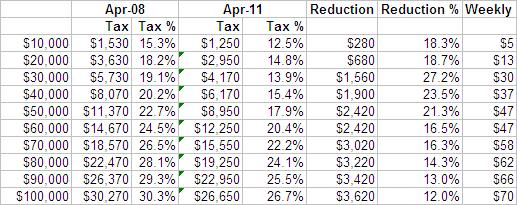
National has announced its tax cut programme and changes to KiwiSaver are going to fund them. National wants to cut the tax credit to employers, and reduce employees' and employers' minimum contribution to 2 per cent of gross income.In his speech notes Key said the bulk of the cut would come on April 1 2009, meaning a worker on the average wage of $48,000 would be better off by an additional $18 a week above Labour's cuts from that date.

But as you can see here, low paid workers won't get much. That may give Clark something to laugh at(stolen from No Right Turn - bigger chart here for the squinters.) And because I really don't have time to analyse who provides the best deal, so go to No Right Turn. In summary if you`re poor, Labour provides the best deal if you're rich National does - and that's why National's package is bigger. Not only do the rich get more, they get it earlier.

I don't like the package at all.


Heres the calculations from Kiwiblog

Labels: , ,

Scoopit! 0 Comments

Saturday, April 19, 2008

KiwiSaver not all it's cracked up to be


The Herald reports that KiwiSaver could make a National Savings loss due to the tax breaks. It is estimated that between 9-19 percent of savings are new savings.

Of the $600 million in KiwiSaver, $300 million is from the Government, $240 million from savers and the rest is split between employers and admin costs. What is not clear is if the $240 million is new savings. Actually, it is clear, most of it probably isn't - as much as 80 percent, according to researchers. If the new savings estimate is closer to 9 percent, that's less than admistration costs, and the Government is pumping $300 million into Kiwi and employer pockets because Kiwis want to get tax breaks by saving $21 million extra, while doing nothing for the National Savings rate.

Some people are using KiwiSaver to reduce savings on other super schemes, others may reduce mortgage payments to get the tax breaks. If so, these people are paying more compounded interest on mortgages - so they are saving the same amount of money but spending more as well over the long run. But if the increased spending on compounded interest is more than the tax breaks, this means that the Government is not only effectively contributing to mortgage payments, you just can't get the money until later, and there is only one group that is better off: the banks.

Given that Cullen is more concerned with our National Savings rate than private savings, this reduction of National Savings should be of concern to him until November.

Labels:

Scoopit! 1 Comments

Powered by Blogger

Clicky Web Analytics